
Skill Matrix: What It Is, How to Create One, and a Free Template Layout
This article is for HR teams, recruiters, and hiring managers. It covers Skill Matrix: What It Is, How to Create One, and a Free Template Layout and how it applies to skills-based hiring.
Published: November 5, 2026
Last updated: November 5, 2026

Quick Answer: A skill matrix is a grid which shows the skills of each team member and their level in each skill, people are listed in rows, skills in columns and every cell gets a rating, it helps hiring teams and managers find skill gaps, plan training and hire the right people.
Who this guide is for: HR managers, team leads, recruiters and founders who assign work, plan training or hire for their team. When to use a skill matrix: use it when one person is the only expert on an important task, when you are planning new hires, or when the training budget feels random. For a team of two or three people, it is usually not needed.
The way companies manage their people has changed a lot in the past few years, teams have become bigger, work has become more technical and the skills a company needs keeps on changing every few months. Managers can no longer depend on memory or guesswork to know who in their team can handle which task, especially when an important project is on the line and the one person who knows the work is on leave.
This is exactly where a skill matrix comes into the picture. Companies and organizations nowadays use a skill matrix to get a clear and simple view of their team's skills, which makes planning, training and hiring more organized, accurate and hassle free.
By the end of this blog, you will be able to understand what a skill matrix is, why it is important, what rating scale to use, how to create one step by step, and the common mistakes which teams should avoid while building it.
What Is a Skill Matrix?
Earlier, managers used to keep the information about their team's skills in their head, or in some old excel file which nobody updated after the first week. A skill matrix(also called skills matrix) is a simple table, which maps the people of a team against the skills needed for the work, and gives a rating to each person for every skill. By using a skill matrix, managers and hiring teams are able to:
See which team member is good at which skill.
Finding out the skills where the team is weak.
Know who can take over a task, when someone is on leave.
Plan training for the people who actually need it.
Deciding what skills the next hire should have.
Think of a skill matrix as a map of your team's skills, which shows not only who is strong, but also the empty areas where nobody in the team has the skill at all.
Skill Matrix Example
Here is a small example of a team skills matrix for a 5 people web team, the ratings are from 0 to 4, where 0 means no skill and 4 means the person is an expert and can teach others.
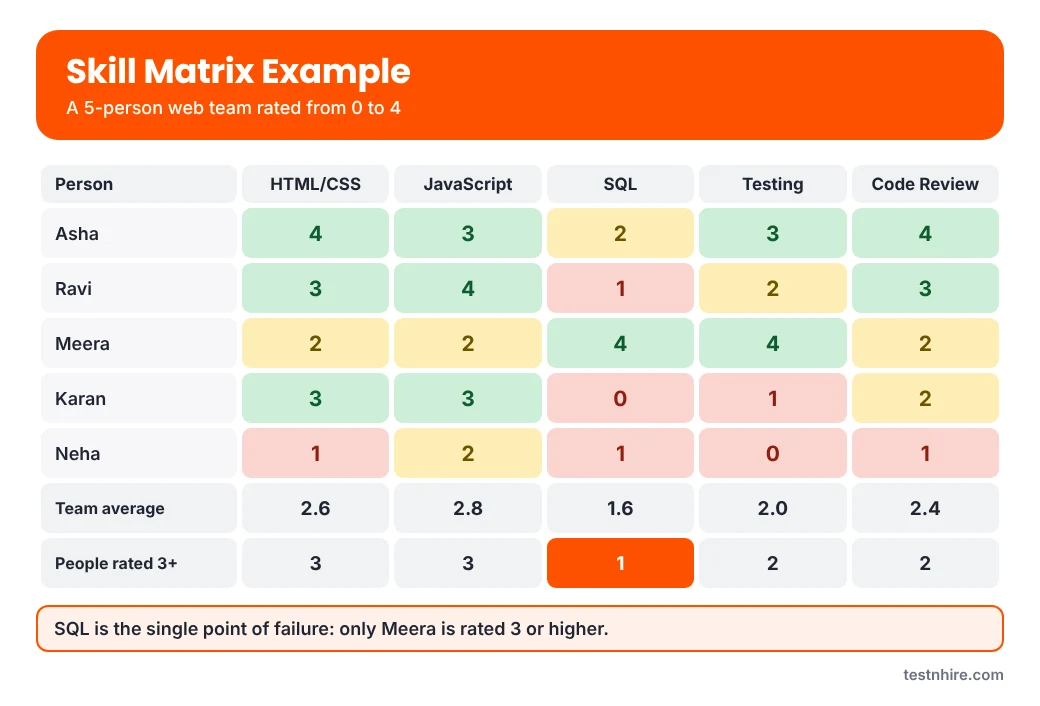
By looking at this table, it becomes clear that SQL is the weakest area of the team, and only Meera is strong in it, which means if Meera is not available, the work related to SQL will get stuck. This is called a single point of failure, and a skill matrix shows it in few seconds.
When I built this example in Google Sheets for this guide, I used the same COUNTIF formula which is explained in the Excel section below, to count how many people scored 3 or more in each skill. The result was 3 for HTML/CSS, 3 for JavaScript, 2 for Testing, 2 for Code Review and only 1 for SQL. The whole sheet with colors and formulas took me around 15 minutes to set up, and the SQL risk was visible in the first look, so that is the skill I would pick first for cross training.
Employee Skills Matrix vs Team Skills Matrix
An employee skills matrix tracks one person across many skills, and is mostly used for reviews and development plans. A team skills matrix on the other hand tracks many people across the same skills, which is used for staffing the projects and checking risks. Most companies need both of these views, and the good thing is one sheet can give both, if it is built properly.
Why Is a Skill Matrix Important Today?
1. Skills are changing fast Tools, software and the way of working keeps on changing every year, a skill which was enough for a role two years back may not be enough today. According to the World Economic Forum's Future of Jobs Report 2025, employers expect 39% of workers' core skills to change by 2030. A skill matrix helps the managers to keep a track of these changes, and update the team skills on time.
2. No more single point of failure In many teams, there is one person who knows a system or a process completely, and when that person leaves or goes on leave, the whole work gets stuck. By using a skill matrix, managers can find these risks early and train backup people before its too late.
3. Better training decisions Companies spend a good amount of money on training, but often the same training is given to the whole team, even to the people who already know the skill. A skill matrix shows exactly who needs training in which skill, which makes the training budget more useful.
4. Smarter hiring One of the biggest benefit of a skill matrix is in hiring, when a new role opens, the hiring team can check the matrix and see which skills are missing in the team, and then hire a candidate who fills that gap. This is what skills based hiring is all about, hiring for the skills a team needs, not just for a job title.
5. Clear growth path for employees When employees can see their current level in a skill and what they need to reach the next level, the career conversations become simple and fair, it also gives them a reason to grow and stay with the company.
Skill Matrix Rating Scale
The rating scale is the heart of a skill matrix, if the scale is not clear, two managers will rate the same person differently and the whole matrix will give wrong picture. A 0 to 4 scale is simple and works well for most of the teams:
It's important to write a small example for each level, which a manager can actually observe in the work. For example "Writes SQL joins across 3 tables" is a clear example, but "Good with data" is not, because everyone will understand it in their own way.
Color coding also makes the matrix easy to read, red for 0 and 1, yellow for 2, and green for 3 and 4, in excel this can be done in seconds by using conditional formatting.
Skill Matrix vs Competency Matrix
Many people get confused between these two terms, and use them like they are the same thing. A skill matrix tracks specific skills which can be taught and tested, like Python, SQL or Excel. A competency matrix on the other hand tracks broader abilities, which includes behaviors like leadership, problem solving and decision making.
For most of the teams, it is better to start with a skill matrix, and add the competency part later, when the team is comfortable with the process.
How to Create a Skill Matrix Step by Step
Creating a skill matrix is not a difficult task, but it needs to be done in a proper way, otherwise it ends up as one more sheet which nobody opens. Here are the steps to follow:
Define the goal, decide why you are making the matrix, is it for training, staffing or hiring.
Pick one team, start with a small team of 5 to 10 people, rather than the whole company.
List the skills, choose 10 to 15 skills which actually affect the work and results of the team.
Set the rating scale, use the 0 to 4 scale and write clear meaning for every level.
Collect the ratings, combine the self rating, manager rating and test scores, to get a fair picture.
Calibrate, sit with the managers for 30 minutes and make sure everyone understands the levels in same way.
Review regularly, update the matrix every quarter, so the data stays fresh.
Skill Matrix Template Layout
A good skill matrix template needs few basic fields, you can copy this layout in any sheet:
It is a good idea to make a second tab in the same sheet for the rating scale, and write the 0 to 4 definitions there, so that every person who is rating reads the same meaning.
Skill Matrix in Excel
You dont need any special software or add-ons for making a skill matrix, Excel or Google Sheets is enough. Follow these steps:
Put the names in column A and skills in row 1.
Type the ratings from 0 to 4 in the cells.
Select the grid and add conditional formatting with a three color scale.
Add =MAX(B2:B6) under each skill to see the team maximum.
Add =AVERAGE(B2:B6) for the team average.
Add =COUNTIF(B2:B6,">=3") to count how many people are strong in each skill.
The COUNTIF row is very helpful, because if a skill shows only 1 strong person, it is a clear sign of risk.
Use Tests Instead of Only Opinions
Self ratings are mostly on the higher side and manager ratings can be subjective, because both depend on memory and mood of the person rating. To make the skill matrix accurate, it's important to add test scores for the skills which can be measured, like coding, Excel, SQL or writing. A short skill test gives a rating based on evidence, not just on someone's opinion. According to a SHRM survey of 1,688 HR professionals in 2022, 56% of employers use pre-employment assessments, and 79% say assessment scores are as important as or more important than traditional hiring criteria.
By using skills assessment tools, hiring teams can test the hard skills of their team in a fair and same way every time, and can also re-test after few months to see if the training actually worked. The same tests from a pre employment skills assessment test library can also be used for candidates, which helps in comparing a new applicant with the current team on the same scale. According to the TestnHire test library, there are 400+ pre-built, role-specific tests available, and programming tests cover 20+ languages, so most hard skills in a matrix can be tested directly.
Skill Gap Analysis With a Skill Matrix
A skill matrix becomes really powerful, when it is compared with the target level of each role, the difference between the current level and the target level is called a skill gap. To run a skill gap analysis:
Set a target level for every skill and role.
Subtract the current rating of each person from the target.
Ranking the gaps based on their impact on the business.
Assign a fix for each gap, which can be training, coaching or hiring.
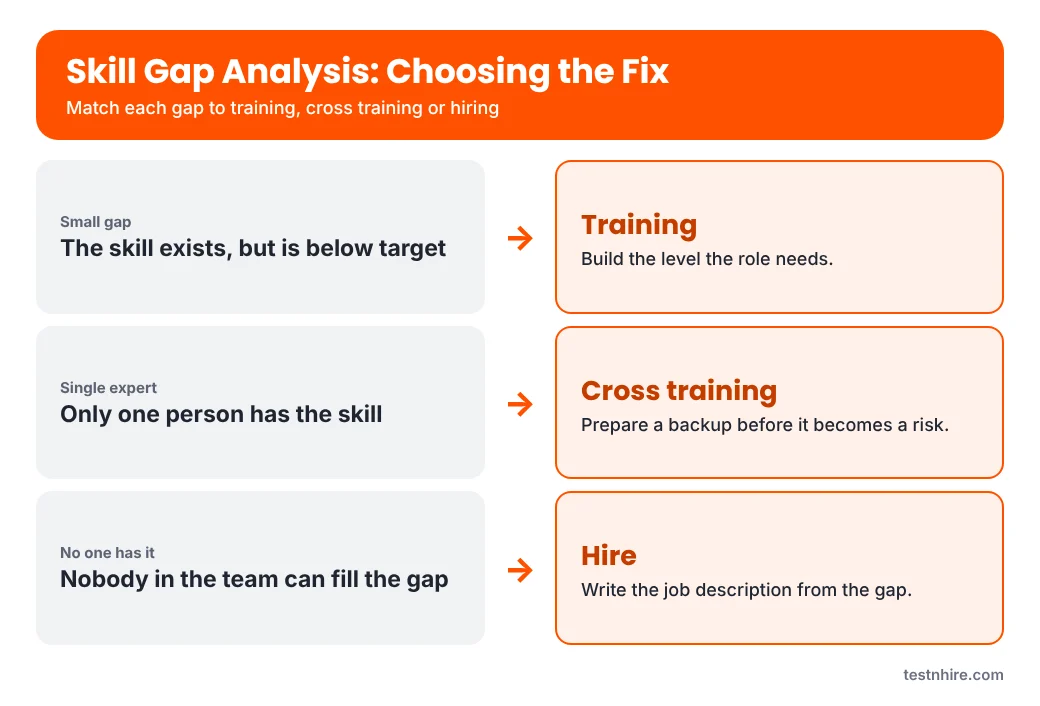
If the gap is small, training is enough. If only one person has a skill, cross training is the best option. And if nobody in the team can fill the gap, it is time to hire, in that case the job description should be written from the gaps, not from a generic template, and the AI job description generator can help in making the first draft quickly.
Common Skill Matrix Mistakes
Listing 40 skills instead of 10 to 15.
Using a rating scale without written definitions.
Trusting only the self ratings.
Building the matrix once and never updating it.
Hiding the matrix from the team it describes.
Finding the gaps and then doing nothing about them.
The first mistake is the most common one, because long lists stop the work before anyone finishes it, it is always better to start small and grow the matrix with time.
Final Thoughts
It will be understatement to say that a skill matrix is just a spreadsheet, in the truest sense it is a clear picture of the strength and weakness of a team. With the work becoming more technical and skills changing faster than ever, it is important for companies to know who can do what, and where the gaps are, before those gaps start affecting the work.
Start small with one team, 10 to 15 skills and a simple 0 to 4 scale, write clear definitions, add test scores instead of only opinions, and review the matrix every quarter. A skill matrix done in the right way, makes training, staffing and hiring faster, smarter and fair, and when you want the ratings to be based on real evidence, a talent assessment platform can make the testing part simple for both your team and your candidates.
{ "@context": "https://schema.org", "@type": "VideoObject", "name": "What Is a Skill Matrix and How to Find Skill Gaps", "description": "See how a skill matrix maps your team's skills, exposes a single point of failure, and helps you decide when to train, cross-train or hire.", "thumbnailUrl": "https://cdn.testnhire.com/uploads/pages_thumbnail_1793868646.webp?alt=V2hhdCBpcyBhIHNraWxsIG1hdHJpeCBhbmQgaG93IHRvIGNyZWF0ZSBvbmU=", "uploadDate": "2026-11-05T14:08:33+05:30", "duration": "PT32S", "contentUrl": "https://cdn.testnhire.com/blog_videos/content_video_6aec40895b02e_1793867913.mp4", "url": "https://testnhire.com/blog/what-is-skill-matrix-how-to-create-and-free-templates", "publisher": { "@type": "Organization", "name": "TestnHire", "url": "https://testnhire.com/" } }

About the Author
Ashish Jain
I’m a Full Stack Developer and the founder of TestnHire, with over 10+ years of experience in web development, technology, talent assessment, and hiring solutions. My focus is on helping businesses make faster, smarter, and more data-driven hiring decisions by leveraging technology, skill-based assessments, and AI-powered recruitment solutions. Through this blog, I share practical insights, hiring strategies, assessment best practices, and real-world expertise to help employers identify the right talent, streamline recruitment, and build stronger teams.


Recent Posts
Share


Frequently Asked Questions:
Need help with something? Here are the most frequently asked questions.

What is a skill matrix?
A skill matrix is a grid which maps people against skills, with a rating in each cell, it shows who can do what in a team.
What is the difference between a skill matrix and a skills matrix?
There is no difference, both terms mean the same grid and teams use them interchangeably.
How to create a skill matrix?
Define the goal, pick a team, list 10 to 15 skills and set a rating scale, then collect ratings, calibrate with managers and review it every quarter.
What is a good skill matrix rating scale?
A 0 to 4 scale works well for most teams, with a clear example written for each level so that every manager rates in the same way.
What does a skill matrix template include?
Employee names, roles, skill columns, target levels, last updated date and the name of the person or test which gave the rating.
How do you make a skill matrix in Excel?
Put names and skills in a grid, enter the ratings, add conditional formatting, and use MAX, AVERAGE and COUNTIF to summarize each skill.


