
Competency Mapping: Frameworks, Levels, and a Step-by-Step Guide
This guide is for HR teams, recruiters, and hiring managers. It gives practical guidance on Competency Mapping: Frameworks, Levels, and a Step-by-Step Guide.
Published: October 30, 2026
Last updated: October 30, 2026
Key Takeaways
- What is Competency Mapping?: Competency mapping defines the skills and behaviors required for each role, along with their target proficiency levels. It transforms vague job descriptions into clear blueprints, helping HR teams hire accurately and plan training.
- What is Competency Mapping?: Competency mapping defines the skills and behaviors required for each role, along with their target proficiency levels. It transforms vague job descriptions into clear blueprints, helping HR teams hire accurately and plan training.
- Core Components of a Map: A solid competency map comprises four essential parts: the specific role, the necessary competencies (skills, knowledge, behaviors), defined proficiency levels, and behavioral indicators for each level.
- Strategic HR Benefits: Competency mapping provides a unified standard across all HR functions, including talent acquisition, performance management, and learning and development. This consistency reduces hiring risks and supports employee engagement through clear role standards.
- Defining Proficiency Levels: The blog recommends using four proficiency levels—Basic, Intermediate, Advanced, and Final—to ensure clear differentiation. Each level must be supported by specific, observable behavioral indicators to enable fair and accurate assessment.
- Step-by-Step Implementation: Key steps include selecting critical roles, listing core tasks by interviewing top performers, defining 6-10 competencies per role, and setting proficiency levels with detailed behavioral indicators for each.

Quick Answer: Competency mapping is the process of listing the skills and behaviors each role needs, then rating the level required. It helps HR teams hire accurately, find skill gaps, and plan training.
Competency mapping turns a vague job description into a clear, scored blueprint. In my 10+ years of building web and hiring technology, I have seen it fix weak hiring and unclear promotions. This guide is for HR professionals, talent leads, and founders who need one shared standard for each role. Use it when interviews disagree, when new hires miss targets, or when you plan training. Skip it for a one-person team with a single role. You will learn the steps, the four proficiency levels, and how to test them.
What Is Competency Mapping?
Competency mapping defines what good performance looks like in a role. It links each role to the competencies that drive results.
Competency Mapping Definition and Core Parts
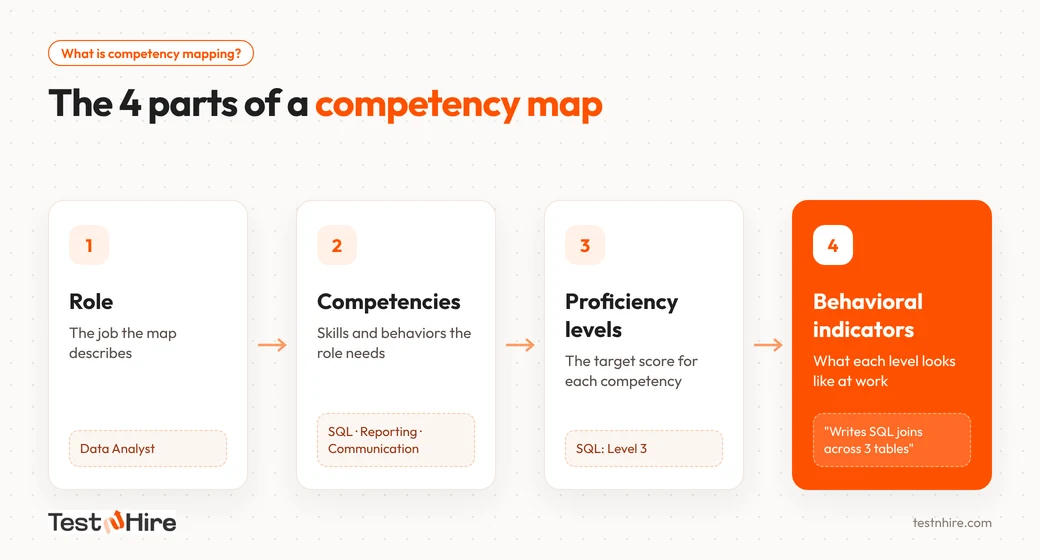
A competency is a measurable skill, knowledge area, or behavior. A competency map lists those competencies for a role and sets a target level for each. Most maps cover technical skills, soft skills, cognitive abilities, and behavioral competencies. Teams usually show it as a table, matrix, or chart.
A solid map has four parts:
- Role: the job the map describes.
- Competencies: the skills and behaviors the role needs.
- Proficiency levels: the target score for each competency.
- Behavioral indicators: short examples of what each level looks like at work.
Why Competency Mapping Matters for HR Strategy
Competency mapping supports HR strategy because every people decision uses the same standard. Your talent acquisition strategy, performance management, learning and development, and talent management all read from one map. That means managers stop arguing about what "strong" means.
The need is large. According to Gallup's 2026 State of the Global Workplace report, 20 percent of employees worldwide were engaged in 2025. That is down from 21 percent in 2024. Clear role standards give managers a base for coaching, which supports engagement.
How Competency Mapping Helps Reduce the Risk of Hiring
A map helps reduce the risk of hiring the wrong person, because it defines success before the first interview. Every interviewer scores the same competencies. It also tells you which pre-employment tests to run for each role.
The shift toward skills-based hiring is backed by data. A 2022 SHRM survey of 1,688 HR professionals found that 56 percent of employers use pre-employment assessments. Of those surveyed, 79 percent ranked assessment scores equal to or above traditional criteria.
The research supports structure. According to Schmidt and Hunter (1998), general mental ability plus a work sample test reached a validity of .63. A map tells you which tests to pair, which means your hiring signal gets stronger.
The Four Proficiency Levels
Each competency needs a scale. Most teams use three to five levels. I recommend four, because four levels force a clear choice and avoid a safe middle score.
Basic, Intermediate, Advanced, and Final Level
| Level | Label | What It Means | Example: Data Analysis |
|---|---|---|---|
| 1 | Basic level of competency | Performs simple tasks with guidance | Builds simple reports in Excel |
| 2 | Intermediate level of competence | Works alone on standard tasks | Cleans data and writes SQL queries |
| 3 | Advanced level of competence | Solves complex problems and coaches others | Designs dashboards and models |
| 4 | Final level of the competency | Sets the standard and shapes strategy | Leads company-wide analytics |
Levels can be numeric, such as 1 to 5, or labeled basic, intermediate, and advanced. Pick one scale and use it across every role.
Write Behavioral Indicators for Each Level
A level without examples is a guess. Write 2 to 3 behavioral indicators for each level. Use verbs that a manager can observe. "Writes SQL joins across 3 tables" is clear. "Good with data" is not.
I wrote indicators for a customer support role across all four levels. I tested them with two team leads over 2 weeks. I compared their ratings of the same 6 agents. We found that the leads rated the same agent at different levels until we added examples. After the rewrite, their ratings matched, which resulted in fairer reviews.
Match the Level to the Role
Not every role needs level 4 in every competency. A junior analyst needs level 1 or 2 in most areas. A team lead needs level 3 in people skills. Set the target level for the role, not for the ideal employee.
Competency Mapping Frameworks and the Skill Matrix
Competency mapping frameworks give the map its shape. Four formats cover most needs.
Common Competency Mapping Frameworks
| Framework | Best For | Strength | Limit |
|---|---|---|---|
| Role-based competency model | Single roles | Precise targets | Slow to build for many roles |
| Job-family framework | Groups of similar roles | Reuse across teams | Less detail per role |
| Behavioral competency framework | Leadership and soft skills | Clear observable examples | Needs trained raters |
| Skill matrix | Team skills at a glance | Fast and visual | Shows less behavior detail |
How to Build a Skill Matrix
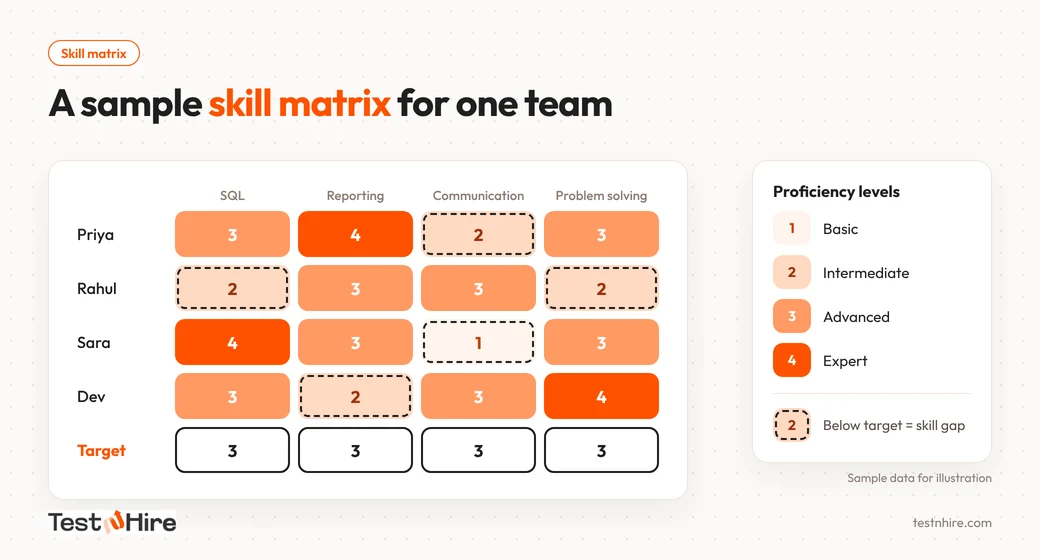
A skill matrix is a grid. Rows list people. Columns list competencies. Each cell holds a level from 1 to 4. It shows gaps and strengths in one view.
Start small. Pick one team of 6 to 10 people and 8 to 12 competencies. Fill the grid with manager ratings first. Then replace the guesses with test scores.
Choose the Framework That Fits Your Team
Use a role-based model for hard-to-fill roles. Use a job-family framework when you manage 20 or more similar roles. Use a skill matrix for a fast first pass. Many teams combine two formats, which means the matrix feeds the detailed model.
How to Do Competency Mapping Step by Step
The process has seven steps. Each step has a time budget, which keeps the project moving.
The Seven Steps
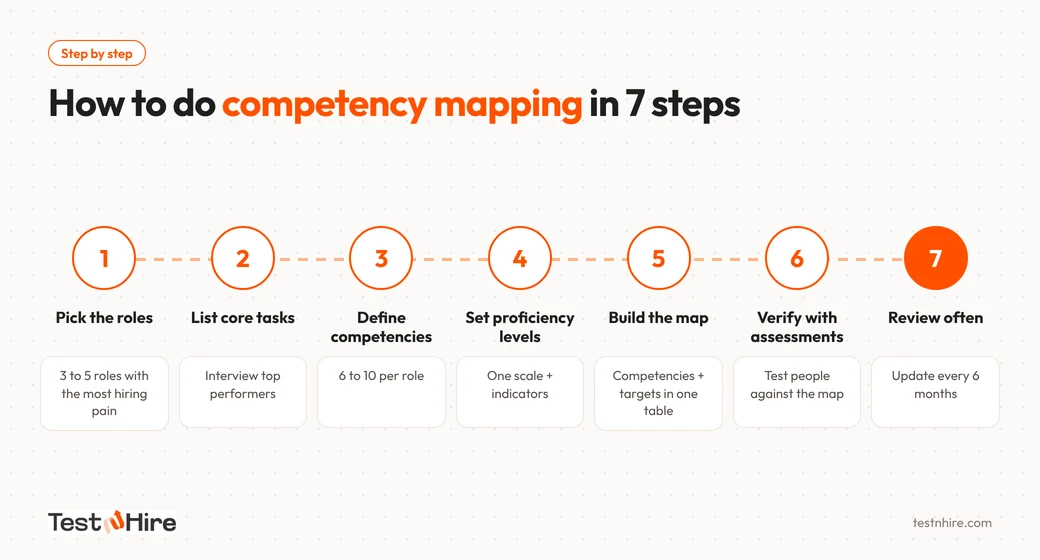
- Pick the roles. Start with 3 to 5 roles that cause the most hiring pain.
- List core tasks. Interview top performers for 45 minutes each.
- Define competencies. Group tasks into 6 to 10 competencies per role.
- Set proficiency levels. Use the four-level scale and write indicators.
- Build the map. Combine competencies and target levels in one table.
- Verify with assessments. Test people against the map.
- Review often. Update the map every 6 months.
I ran this process for a sales role in 3 weeks. I opened a spreadsheet, pasted the task list, and logged the top eight competencies. I clicked through 12 call recordings to confirm them. I noticed that the best performers shared two habits that the job description left out. That turned out to be the most useful finding.
Align Job Descriptions and Interviews
Rewrite the job description from the map in under 2 hours. A job description generator speeds up the draft. Then build interview questions from the same competencies. The AI interview questions generator can draft questions you edit. Score every answer on the 4-level scale, and add the test step to your candidate screening workflow right after shortlisting.
Use Competency Mapping in Performance Management
Competency mapping gives performance management a fair base. Reviews compare an employee with the target level, not with a coworker. Managers can then explain a rating with behavior examples. Link each gap to a development goal, which means every review ends with an action.
Identifying Skills Gaps With Assessments
A map shows what a role needs. An assessment shows what a person has. The difference is the gap.
Skill Gap Analysis in Four Steps
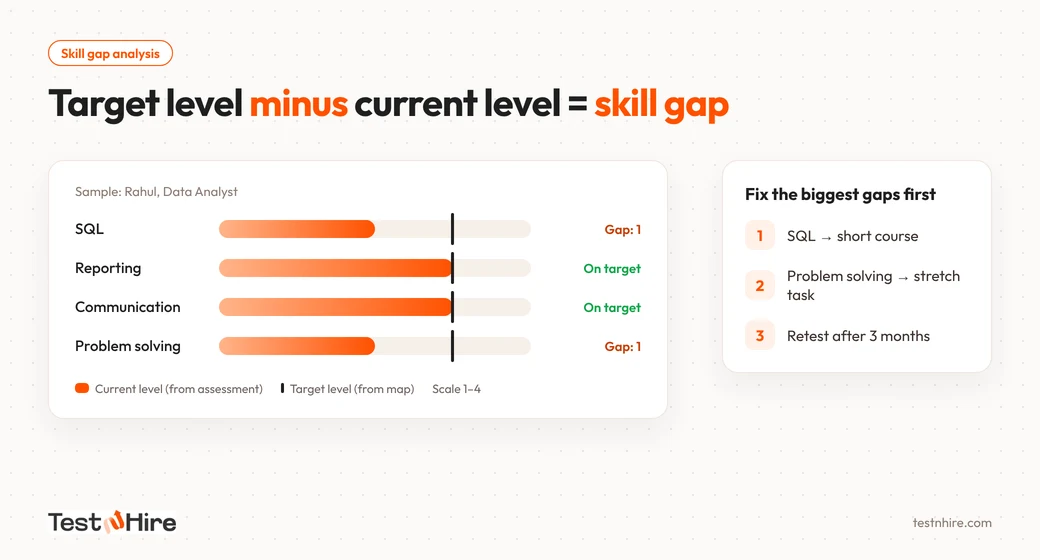
Skill gap analysis compares current levels with target levels. Run it in four steps:
- Test each person on the competencies in their map.
- Subtract the current level from the target level.
- Rank the gaps by business impact.
- Assign a fix: course, coaching, or stretch task.
Identifying skills gaps this way replaces opinion with data. The AI skill gap analyzer shows where a person stands against a target role.
Match Each Competency to a Test
Pick the test type that fits the competency. A programming test fits technical skills. A cognitive ability test fits analysis. A situational judgment test fits decision-making. A language test fits communication.
You can pick ready-made pre-employment skills assessments by role, or build a custom role-specific test and set the difficulty for each level. If you are new to this, start with how to create a skills assessment test that matches your map.
I built a custom test for the intermediate level of a finance role. I added 10 questions and set a pass score. I ran it on 5 current employees first. The result was a clean split: three passed and two needed coaching. In practice, that matched what their managers had said.
Feed the Results Into Learning and Development
Learning and development works best when it follows the gap list. Assign training only where the data shows a gap. That saves budget, because you stop teaching skills people already have. Retest after 3 months. The new score shows whether the training worked. Each skills assessment then becomes a progress check.
Using People Analytics and Talent Management
Competency data becomes more useful when you track it over time.
Competency Mapping and People Analytics
People analytics uses workforce data to guide decisions. Competency scores are clean data for it. You can track average level by team, gaps by role, and growth by quarter. Start with three charts: current level vs target, gaps by team, and score change after training.
Talent Management and Succession Planning
Talent management uses the map to spot future leaders. Compare high performers with the level 3 and level 4 indicators for the next role. Build a readiness list for each key role. According to LinkedIn, 93 percent of organizations are concerned about employee retention. Learning opportunities are the top method they use to address it. A map shows people a path, which means they see a reason to stay.
Mistakes HR Professionals Should Avoid
- Mapping every role at once.
- Writing levels with no behavior examples.
- Skipping assessments and relying on manager opinion.
- Treating the map as a one-time project.
- Using one scale for some roles and another for the rest.
The first mistake is the costliest, because teams burn out before they finish. I saw one project stall after 8 weeks for this reason. Restarting with 3 roles fixed it, and the team ended up finishing in 4 weeks.
Conclusion
Competency mapping gives every role a clear, scored standard. Define the competencies, set four proficiency levels, and write behavior examples. Use a skill matrix for a fast start and a role-based model for key roles. Then run a skill gap analysis with tests, and feed the results into learning and development. Start with 3 roles this month, and verify each level with a role-based test before you use the map for hiring.

About the Author
Ashish Jain
I’m a Full Stack Developer and the founder of TestnHire, with over 10+ years of experience in web development, technology, talent assessment, and hiring solutions. My focus is on helping businesses make faster, smarter, and more data-driven hiring decisions by leveraging technology, skill-based assessments, and AI-powered recruitment solutions. Through this blog, I share practical insights, hiring strategies, assessment best practices, and real-world expertise to help employers identify the right talent, streamline recruitment, and build stronger teams.


Recent Posts
Share


Frequently Asked Questions:
Need help with something? Here are the most frequently asked questions.

What is competency mapping?
Competency mapping lists the skills and behaviors a role needs and rates the level required. It gives HR a shared standard.
What are the steps in competency mapping?
Pick roles, list tasks, define competencies, and set levels. Then build the map, verify it with assessments, and review it often.
What are the proficiency levels in competency mapping?
Most maps use three to five levels. A four-level scale runs from the basic level of competency to the final level of the competency.
What is the basic level of competency?
The basic level of competency means a person performs simple tasks with guidance. It is the entry score on the scale.
What is the intermediate level of competence?
The intermediate level of competence means a person works alone on standard tasks and handles routine problems.
What is the advanced level of competence?
The advanced level of competence means a person solves complex problems and coaches others.


